

Collaborative Research: Breaking Information Sharing Barrier at Signal Level: A Learning-based Interference Mitigation for Pay-As-You-Go Spectrum Sharing
Project Information
NSF award number: 2434001
Project period: 10/1/2024 – 9/30/2027
Principal investigator: Dr. Huacheng Zeng
Graduate student:
Ruxin Lin
Kunzhe Song
Geo Zhou
Project Overview
The growing stress from spectrum shortages and the increasing demand for wireless applications are propelling spectrum management into its fourth era. The “Pay-As-You-Go and Cooperative Sharing” vision is poised to be a promising new paradigm for spectrum management in Spectrum Era 4. In this vision, despite cooperation among wireless users, the information they can share is limited to userapplication or systemprotocol-level parameters (e.g., spectrum requirements, interference tolerance levels, wireless standards, and waveform types). However, signal-level information, representing instantaneous transmission details of individual data packets (e.g., channel coefficients), cannot be shared in a timely manner across different wireless networks due to delays in cross-network information exchange. This project aims to fill this critical gap by investigating interference mitigation techniques for wireless devices in the absence of signal-level interference information. The research team will design learning-based approaches for individual radio devices to decode their data packets in the presence of unknown interference. The team will also integrate the proposed interference mitigation algorithms into 5G Open Radio Access Networks (O-RANs) and evaluate their performance in realistic scenarios through comprehensive experimentation. Moreover, the project will promote the participation of students in wireless communications research. It will also enhance pedagogical activities by developing new course materials based on the research findings.
The research team will focus on three thrusts to enable transparent and concurrent spectrum utilization for heterogeneous wireless network systems by developing learning-based approaches capable of mitigating unknown interference. First, the team will design supervisory learning algorithms for interference mitigation by leveraging the reference symbols in physical-layer signal frames and the spatial degrees of freedoms provided by a radio device?s multiple antennas in sub-10GHz wireless systems, with the goal of enabling individual radio devices to decode data packets in the presence of unknown interference. Second, the team will design online-learning-based beamforming methods for interference mitigation in millimeter-wave (mmWave) systems, aiming to maximize transmission data rates despite interference with unknown signal-level features. Third, the team will integrate the proposed interference mitigation algorithms into a 5G O-RAN testbed and explore computational acceleration methods (e.g., using specialized hardware) to meet the real-time requirements. The proposed interference mitigation algorithms will be evaluated through comprehensive over-the-air experiments in realistic scenarios.
The team at Michigan State University will focus on the development of interference mitigation techniques for wireless communication systems.
Publications
Self-Supervised Doppler-Guided RF Odometry
Kunzhe Song*, Jialuo Du, Jingkai Lin, and Huacheng Zeng
NeurIPS 2026.
Pay-As-You-Go via Spectrum Bux: A New Paradigm for Dynamic Spectrum Access
Naru Jai, Yi Shi, Huacheng Zeng, Yang Xiao, Wenjing Lou, Y Thomas Hou
IEEE Communications Magazine.
SOPAR: Bee Localization and Tracking Using RF Sub-harmonic Oscillating Parametric Resonator in Hive Environments
Qijun Wang*, Peihao Yan*, Geo Jie Zhou*, Xiang Liu, Dan Stanley, Zach Huang, Chunqi Qian, Huacheng Zeng
Proceedings of the ACM on Interactive, Mobile, Wearable and Ubiquitous Technologies (IMWUT), 2026.
[PDF]
An LLM-Guided RF Backscatter System for Through-Wall Keystroke Inference
Qijun Wang*, Chunqi Qian, Huacheng Zeng
IEEE Symposium on Security and Privacy (S&P), 2026. [Acceptance rate: 13%]
[PDF] [arXiv] [Project Website] [Demo Video]
Integrating Health Sensing into Cellular Networks: Human Sleep Monitoring Using 5G Signals
Ruxin Lin*, Peihao Yan*, Jie Lu*, Qijun Wang* and Huacheng Zeng
IEEE INFOCOM WKSHPS: ISAC-FutureG 2026.
[PDF] [arXiv]
Spectrum Shortage for Radio Sensing? Leveraging Ambient 5G Signals for Human Activity Detection
Kunzhe Song*, M. Zingraff*, and Huacheng Zeng
IEEE INFOCOM 2026. [Acceptance rate: 18.9%]
[PDF] [arXiv]
Near-Real-Time Resource Slicing for QoS Optimization in 5G O-RAN Using Deep Reinforcement Learning
Peihao Yan*, Jie Lu*, Huacheng Zeng, and Y. Thomas Hou
IEEE/ACM Transactions on Networking, 2025.
[PDF] [Source Code]
xDiff: Online Diffusion Model for Collaborative Inter-Cell Interference Management in 5G O-RAN
Peihao Yan*, Huacheng Zeng, and Y. Thomas Hou
IEEE/ACM Transactions on Networking, 2025.
[PDF] [Source Code]
Anti-Jamming 5G Millimeter-Wave Communication via Joint Analog and Digital Beamforming: A Bayesian Optimization Approach
Peihao Yan*, Bowei Zhang*, Shichen Zhang*, Kai Zeng, and Huacheng Zeng
IEEE Transactions on Machine Learning in Communications and Networking, 2025.
[PDF]
Research Activities and Outcomes
Year 2: Using ambient 5G spectrum for human activity detection
Problem description: New radio-sensing systems compete for scarce spectrum below 10 GHz, where cellular, Wi-Fi, and other services already operate. This work investigates whether a standalone sensing device can reuse existing 5G transmissions to estimate human body outlines and skeletons. Reusing an operating 5G waveform is relevant to the project's broader goal of making more productive use of shared spectrum.
Technical Challenge: Ambient 5G signals carry unknown, changing data symbols and are affected by multipath, noise, and signals in adjacent bands. Human reflections are weak and sparse, so the system must recover stable motion and direction features without coordinating with the 5G transmitter or requiring a dedicated sensing waveform.
Our approach and method: We built Ambient Radio Sensing (ARS), a device that receives an existing 5G signal, amplifies and forwards it toward nearby objects, and self-mixes the reflected signal with a copy of the received waveform. A directional patch antenna limits out-of-band pickup, while signal sanitization removes bias and outliers. An array of receiving antennas and differential beamforming produce motion heatmaps. A transformer-based model learns to infer body masks and skeletal keypoints from these heatmaps, using synchronized camera-derived labels during training; inference uses radio signals alone.
Experimental results: A prototype using a private O-RAN 5G base station was evaluated in eight indoor and outdoor scenes, with 51,677 held-out test samples. ARS achieved 0.5097 average precision for body-mask segmentation and 0.3997 average precision for keypoint estimation, compared with 0.4805 and 0.3469, respectively, for the SiWiS baseline. At the stricter mask threshold of 0.80 intersection-over-union, ARS reached 0.2624 average precision versus 0.1055 for SiWiS. Accuracy improved as the radio observation window approached four seconds and declined as subjects moved from two to six meters away, particularly for wrists and ankles.
Year 2: Using 5G cellular spectrum for human sleep monitoring and detection
Problem description: Existing sleep-monitoring approaches often depend on wearable devices or dedicated in-home sensing equipment. This work investigates whether a cellular network can instead use signals from a smartphone placed near a bed to estimate breathing rate and recognize body movements without a wearable. It extends the project's use of practical 5G infrastructure by examining a sensing service that can operate on measurements already available to a base station.
Technical Challenge: Breathing produces subtle channel changes that can be masked by nearby movement, wall attenuation, and phase offsets between the phone and base station. Sleep movements are brief and irregular, making them harder to classify with a fixed signal-processing rule.
Our approach and method: We configure the phone to transmit periodic 5G uplink sounding reference signals and collect channel state information (CSI) at the base station. A ratio of CSI measurements from different antennas reduces common phase distortions; filtering and a signal-quality measure select a reliable amplitude- or phase-based breathing estimate. For movement recognition, normalized CSI amplitudes from multiple antennas, frequencies, and time points feed a convolutional neural network that classifies body turns, sitting up, arm movements, and leg movements. The implementation forwards CSI through the O-RAN E2 interface to an xApp for inference.
Experimental results: Tests on an indoor private 5G network with commercial radio units and smartphones covered five locations. Breathing-rate estimates had an average error of 8.8% across those locations. The movement classifier achieved 85.5% accuracy on a held-out set of 340 samples, with accuracy above 80% for each location and movement category. The study also found that ordinary activity more than one meter from the subject did not prevent breathing extraction in its tested settings; performance worsened where thick walls caused substantial signal loss.
Year 1: Interference mitigation for concurrent spectrum use of Wi-Fi and cellular networks without cross-network coordination
Problem Description The explosive growth of wireless devices and applications has intensified the demand for spectrum, creating severe challenges for accommodating heterogeneous networks within limited frequency bands. Among the most pressing issues is the coexistence of WiFi and LTE systems, both of which are widely deployed and increasingly overlap in unlicensed bands. Conventional spectrum sharing strategies often require explicit coordination mechanisms such as inter-network signaling, centralized schedulers, or tight synchronization across different technologies. While effective in theory, these solutions are difficult to implement in practice because WiFi and LTE are governed by independent standards, operated by different entities, and designed with inherently different medium access mechanisms. As a result, the lack of transparent coexistence solutions has become a critical bottleneck in achieving efficient and scalable spectrum utilization.
Methodology To address this challenge, we propose a transparent coexistence scheme for WiFi and LTE that does not rely on cross-network coordination or inter-system synchronization. The core enabler of our approach is a blind interference cancellation technique that allows a multi-antenna receiver to decode its intended signal even in the presence of unknown and potentially strong interference from a coexisting network. Unlike coordination-based approaches, this method empowers each network to operate independently, while still ensuring that overlapping transmissions can be effectively separated and decoded. By doing so, our solution reduces protocol overhead, preserves backward compatibility with existing devices, and eliminates the need for complex inter-network agreements.
Design The design of our scheme builds upon advanced signal processing techniques for interference suppression in multi-antenna systems. At the physical layer, the receiver applies spatial filtering and blind source separation methods to isolate the desired WiFi or LTE signal from interfering transmissions. Crucially, this is achieved without prior knowledge of the interfering signal’s modulation, coding, or protocol structure, making the approach robust to heterogeneous coexistence scenarios. Furthermore, the scheme is designed to adapt to varying channel conditions and interference levels, ensuring reliable decoding even in dense environments where interference is both dynamic and unpredictable.
Validation To validate the practicality of the proposed scheme, we developed a prototype implementation on a software-defined radio (SDR) testbed. The prototype integrates our blind interference cancellation algorithm with standard WiFi and LTE transceivers, enabling real-time evaluation in an indoor wireless environment. Experimental results demonstrate that the system can sustain reliable data transmission for both WiFi and LTE users under simultaneous operation, thereby confirming the feasibility of transparent coexistence. This proof-of-concept implementation highlights the potential of blind interference cancellation as a scalable and deployable solution for spectrum sharing, paving the way toward more efficient use of unlicensed bands in future wireless networks.
Year 1: Anti-jamming 5G mmWave communications
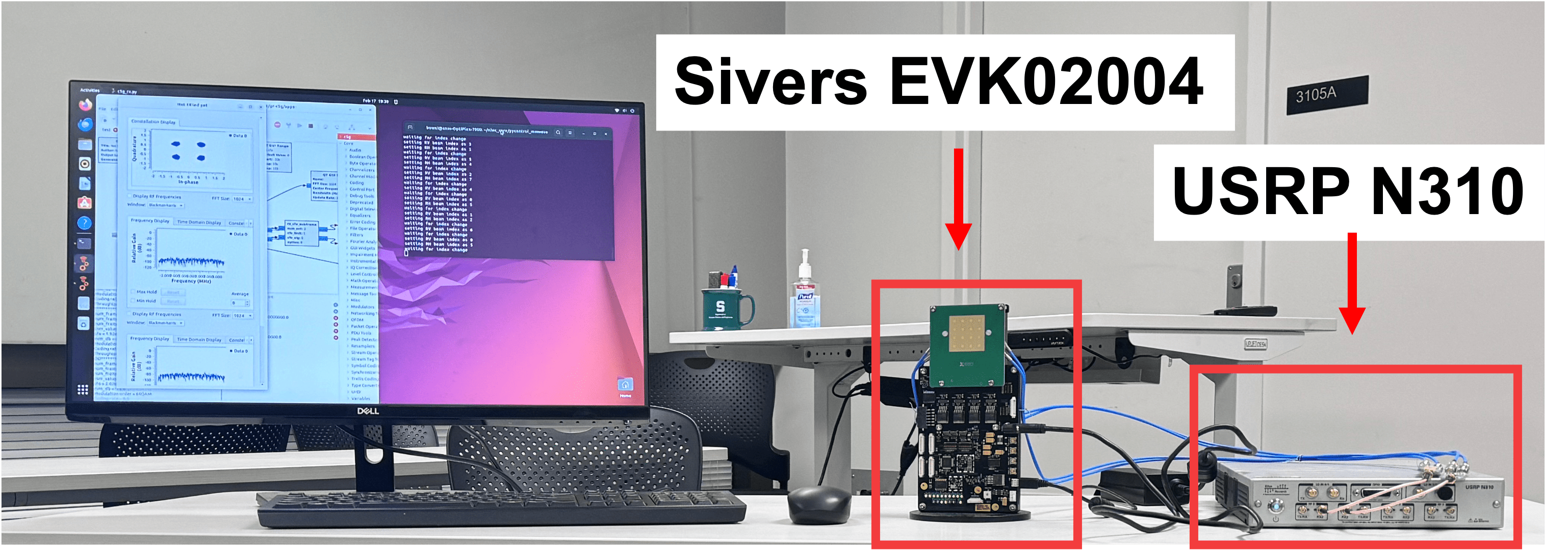
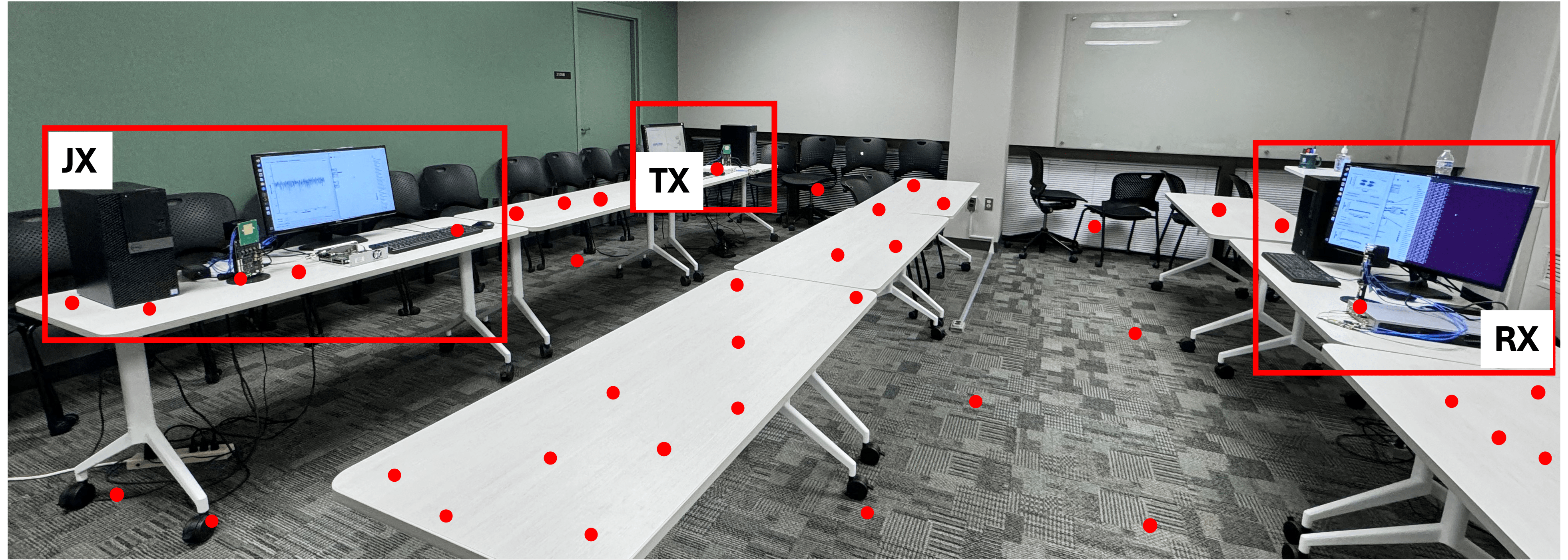
Reliable 5G millimeter-wave (mmWave) communications are essential for supporting bandwidth-intensive and latency-sensitive applications such as immersive extended reality (XR), autonomous vehicles, and industrial automation. However, ensuring reliability in mmWave systems remains challenging due to their inherent susceptibility to radio interference, blockage, and intentional jamming attacks. These disruptions can severely degrade link quality, compromise user experience, and undermine the robustness of mission-critical services.
To address these challenges, this project presents a joint analog–digital beamforming scheme for 5G mmWave receivers that enables robust data packet decoding in the presence of strong jamming signals. The proposed design combines two complementary techniques:
Online-learning Bayesian optimization for analog beamforming: This framework dynamically adapts the analog beam direction to maximize signal quality while suppressing interference, even under rapidly changing wireless conditions.
Modified Minimum Mean Square Error (M-MMSE) digital detection: At the digital baseband stage, this detector further mitigates residual interference by optimally balancing noise suppression and signal recovery.
By integrating these two techniques, the receiver can effectively suppress jamming in both the analog and digital domains, providing enhanced resilience and significantly improving decoding performance under adversarial conditions. This cross-layer beamforming strategy allows the system to leverage fast analog adaptation with intelligent digital processing, thereby achieving both robustness and efficiency.
We have developed a 28 GHz over-the-air (OTA) testbed prototype to validate the proposed scheme under realistic conditions. Extensive experimental evaluations across diverse scenarios demonstrate that the system maintains high decoding reliability even under targeted jamming, highlighting its potential for practical deployment in future 5G and beyond networks.
Key features of the proposed system include:
joint analog–digital beamforming for multi-domain interference suppression,
online-learning frameworks for adaptive beam selection,
real-time resilience against jamming attacks, and
comprehensive OTA evaluation on a mmWave testbed.
Broader Impacts
Broadening Access to Intelligent 6G O-RAN Research through Community Engagement and Public Dissemination
On August 6, 2026, Dr. Huacheng Zeng delivered a research talk to the ARA team at Iowa State University as part of the broader impacts activities of this project. The presentation shared research toward intelligent, application-aware, and perception-enabled 6G Open Radio Access Networks (O-RAN). It covered three complementary directions: deep reinforcement learning and graph-based network representations for automated network control; intelligent handover and mobility management to support reliable, low-latency edge AI applications; and integrated sensing and communication to enable environmental perception. These topics connected advances in wireless networking and AI to the capabilities and potential societal benefits of future wireless infrastructure.
The activity supported knowledge exchange across institutions and exposed the ARA team to methods relevant to programmable wireless systems and application-driven network design. By connecting network optimization, distributed AI, and wireless sensing, the presentation provided an interdisciplinary perspective useful for research and education at the intersection of communications, computing, and machine learning. These directions also have potential relevance to ARA’s mission in rural wireless connectivity and applications, including precision agriculture and community services, offering opportunities to explore how emerging O-RAN capabilities could address practical needs.
To extend access beyond the live audience, the talk recording was made publicly available on YouTube. This dissemination provides an educational resource for students, researchers, practitioners, and other interested viewers, allowing them to engage with the material regardless of location or availability during the event. By combining engagement with an external research team and public access to the presentation, the activity broadened the availability of project-related knowledge and supported continued learning about next-generation wireless technologies.
International Research Exchange on Integrated Sensing and Communication in O-RAN
On May 22, 2026, Dr. Huacheng Zeng presented “OFDM-Based Monostatic ISAC in O-RAN” at the NSF–NICT Joint Workshop in Japan, supporting the broader impacts of this project through international research dissemination and knowledge exchange. The presentation connected the project’s focus on intelligent, programmable O-RAN infrastructure with emerging integrated sensing and communication (ISAC) capabilities. Examples included three-dimensional scene reconstruction, human pose and facial expression estimation, and sensing using 5G phone signals. These examples illustrated how wireless infrastructure could support services beyond connectivity, with potential applications in vital sign monitoring, elderly fall detection, localization, and activity recognition. Sharing these research directions with the workshop audience broadened awareness of the potential societal benefits of combining wireless communications, sensing, and artificial intelligence.
The presentation also supported U.S.–Japan research exchange by identifying open challenges and opportunities for future collaboration. These included developing shared datasets and benchmarks, improving AI model generalization in unfamiliar environments, combining radio sensing with camera observations, and assessing the reliability, cost, and power requirements of different sensing architectures. The discussion of security and privacy emphasized considerations relevant to the responsible development of wireless sensing, particularly in applications involving people and their daily activities. By presenting both emerging capabilities and unresolved challenges, the talk provided a basis for collaborative investigation and helped connect the project’s O-RAN research to a broader international community working toward useful, reliable, and socially beneficial next-generation wireless systems.
Zeng gave talk on 5G signal implementation on SDR to George Mason University students
Dr. Zeng was invited to deliver a guest lecture on 5G signal implementation to students in the Department of Electrical and Computer Engineering at George Mason University. The lecture aimed to bridge theoretical foundations with practical system design, providing students with both a high-level perspective of 5G networks and a detailed technical understanding of their operation. The talk began with an introduction to the 5G signal frame structure, where Dr. Zeng explained the principles of numerology, subcarrier spacing, and time-slot organization, emphasizing how these design choices enable high data rates, low latency, and flexible spectrum usage. He then discussed the MAC-layer protocols, illustrating how scheduling, HARQ mechanisms, and link adaptation contribute to efficient radio resource management. At the transport layer, he described the challenges of ensuring reliability, low latency, and scalability, particularly in high-mobility scenarios. Building on this foundation, Dr. Zeng integrated results from this project to highlight the evolution of network architectures. He introduced the Open RAN (O-RAN) paradigm, stressing its role in decoupling hardware and software, enabling multi-vendor interoperability, and fostering innovation through software-defined and virtualized components. He further explored how artificial intelligence and machine learning are becoming integral to modern network design, offering capabilities such as adaptive resource management, self-optimization, and anomaly detection. The lecture concluded with a discussion on future research challenges and opportunities. The talk provided students not only with a technical dive into 5G but also with a forward-looking perspective on how emerging technologies will shape the next generation of wireless systems.
Zeng hosts undergraduate student to work on experimental research on O-RAN
Zeng's INSS Laboratory provides undergraduate the student with unique opportunities to participate in experimental research on Open Radio Access Networks (O-RAN). The lab emphasizes hands-on learning, enabling the student to engage directly with both the software and hardware that form the backbone of modern wireless communication systems. By immersing themselves in practical experimentation, the student develop not only technical expertise but also the ability to tackle complex systems-level challenges. The student studies open-source RAN software platforms, including srsRAN and the OpenAirInterface (OAI) fronthaul interface (FHI) 7.2 split. These platforms provide a flexible and transparent environment for exploring 5G networks, making them ideal for academic research. The student work on implementing a complete O-RAN system. This involves integrating Benetel O-RUs (O-RAN Radio Units) with srsRAN-based gNB components. The integration process gives the student direct experience with the O-RAN Alliance's principles of disaggregation and openness, where hardware and software from different vendors can be combined to create a fully functioning system. This stage of the project highlights the real-world engineering challenges of interoperability across heterogeneous components. In addition to system integration and debugging, the student conduct performance evaluations of the deployed O-RAN setup. He measured and analyzed system behavior using commercial smartphones connected through the Benetel RU and srsRAN core components. Performance metrics such as throughput, latency, and stability are assessed under different configurations, allowing the student to understand how design choices in open-source RAN implementations affect end-user experience. These experiments not only test the limits of the platforms but also contribute to ongoing efforts to make open RAN technologies viable for real-world applications. By working with real hardware and open-source software, the student develop a holistic view of the opportunities and challenges in building O-RAN systems.