RA positions in machine learning and wireless networking/sensing systems are available in my group.
Selected students will receive full support including tuition remission, monthly stipend, and health insurance.
If interested, please send me an email with your CV attached.
Research Interests
AI for wireless networking
5G, 6G, O-RAN
Reinforcement learning
Online optimization
mmWave and beamforming
Backscatter communications
Network testing and validation
Physical-layer attacks and defense
AI for wireless sensing
Integrated sensing and communication (ISAC)
Human activity recognition
Vital sign detection
Localization and tracking
RF sensing for healthcare
3D scene reconstruction
6G for AI Infrastructure
Mobile edge computing (MEC)
Edge AI offloading for VR
Joint networking and computing optimization
AI-aware network optimization
Distributed AI training/inference
Recent Research Projects
5G Edge AI Offloading for VR Headset
VR headsets and AR glasses are fundamentally constrained by limited battery capacity and on-device computational resources. As a result, advanced AI applications on these devices increasingly rely on edge AI offloading. In this project, we developed a 5G O-RAN system with optimized user mobility management for delay-critical edge AI offloading using temporal graph embeddings. The accompanying video demonstrates a smooth human boxing application on a VR headset enabled by this 5G edge AI offloading pipeline: the headset streams camera images to a 5G edge AI server, and receives in real time the detected human bounding boxes along with the round-trip latency of the offloading process.
MSU's Private 5G Network
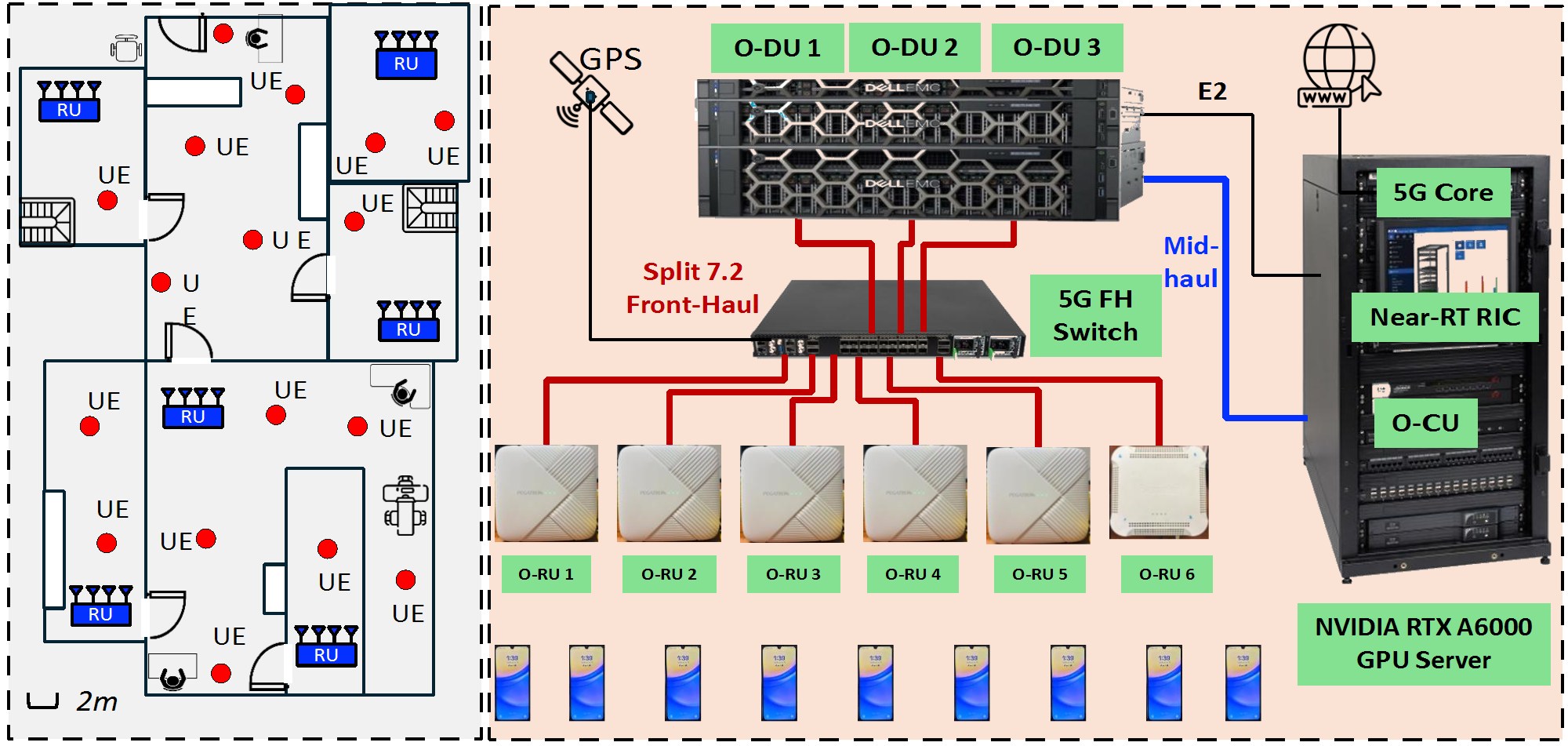
We built the first private 5G network on MSU campus. The network comprises six commercial indoor O-RUs, one commercial outdoor O-RU, and 20+ smartphones. The system is deployed on the third floor of MSU Engineering Building. This 5G network testbed supports both OpenAirInterface and srsRAN stacks. Four NVIDIA GPU A6000 devices have been installed for Near-RT RIC.
Measurement of Real-Time Uplink CSI in MSU's Private 5G Network
5G uplink Channel State Information (CSI) include not only MIMO channel matrix coefficients but also Time Advance (TA). Additionally, 5G operates in master-slave mode so the network can proactive hand over a smartphone from one gNB to another. This video shows the CSI measurement at a commercial base station from a smartphone when the user is standing and walking.
Facial Expression Reconstruction using 5G mmWave Signal
5G mmWave signals can be used to estimate human facial expressions. The left (blue) image shows the facial expression reconstructed using a depth camera, which serves as the ground-truth label. The right (orange) image shows the facial expression reconstructed solely from 5G mmWave signals using deep learning models.
Human Skeleton Reconstruction using Wi-Fi Signal
Radio signals from a commercial Wi-Fi router are used to estimate the skeleton of a walking person using an AI model. The overlaid green skeleton is generated by a camera using an off-the-shelf computer vision algorithm and serves as the ground-truth label for training the AI model. The overlaid red skeleton represents the skeleton estimated solely from the Wi-Fi signals.
3D Scene Reconstruction using 5G mmWave Signal
We built a bistatic ISAC device that uses 5G mmWave signals for sensing using RFSoC 4x2 and Sivers EVK. The sampling rate is 1.2288GSPS and the carrier frequency is 60GHz. The device operates in full-duplex mode: it transmits 5G signals for communication while simultaneously receiving the backscattered signals for sensing. As the device moves, it generates radio images of the surrounding scene in real time.
Bee Localization and Tracking using Tiny RF Backscatter Tag
A miniature backscatter tag, less than 4 mm in diameter, was designed and fabricated for bee tracking. The tag was attached to the thorax of a bee (see video), while an RF reader was installed outside the beehive. When excited by the RF reader, the tag generates a sub-harmonic response, which is used to localize and track the bee.
Awards and Honors
Honorable Mention Recognition, ACM CHI, 2025.
Best Paper Award, IEEE SECON 2021
NSF CAREER Award, 2019
Distinguished Member of IEEE INFOCOM TPC, 2019, 2021, and 2023
Best Student Paper Award of ACM WUWNet, 2014
Services
Editor, IEEE Transactions of Wireless Communications, 2025–present
General Co-chair, IEEE INFOCOM 2026 Workshop – ISAC-FutureG
Workshop Co-chair, ACM MobiHoc 2026
Co-chair of EDAS, WiOPT 2026
TPC Vice Chair for Information Systems and Publication Co-Chair, IEEE INFOCOM 2025
Co-chair of Student Travel Grant, IEEE INFOCOM 2024
Co-chair of Student Travel Grant, ACM MobiHoc 2023
Co-chair of Poster/Demo Workshop, IEEE INFOCOM 2022, 2023
Co-chair OF Publicity, IEEE INFOCOM 2020, 2021
Co-chair of Publicity, IEEE WCNC 2021
TPC, IEEE INFOCOM 2015–present
TPC, ACM MobiHoc 2022, 2023, 2024, 2025, 2026
TPC, WiOpt 2021
TPC, IEEE/ACM International Symposium on Quality of Service (IWQoS) 2021